
Protect your stock
from sharks.
Kaien Farming (養殖用) is a permanent electrical shark deterrent designed for fish pens, salmon cages, and tuna ranches. Tested at Sagami Bay, Japan, 2022. Installed once, running continuously.
Shark predation
is an industry cost.
サメ被害は業界全体の損失です。
As ocean temperatures rise and shark populations recover in regulated waters, interactions between sharks and aquaculture operations are increasing worldwide. Sharks breach net pens, destroy equipment, and expose stock to open water. A single incident can mean tens of thousands of fish at risk and weeks of operational disruption.
Existing responses have significant limitations. Predator exclusion nets are expensive to install and maintain, and impede water flow and feeding access. Acoustic deterrents have shown inconsistent effectiveness against persistent predators. Culling is ecologically harmful and in many jurisdictions legally restricted.
The industry has needed an effective, humane, low-maintenance solution. Kaien Farming is it.
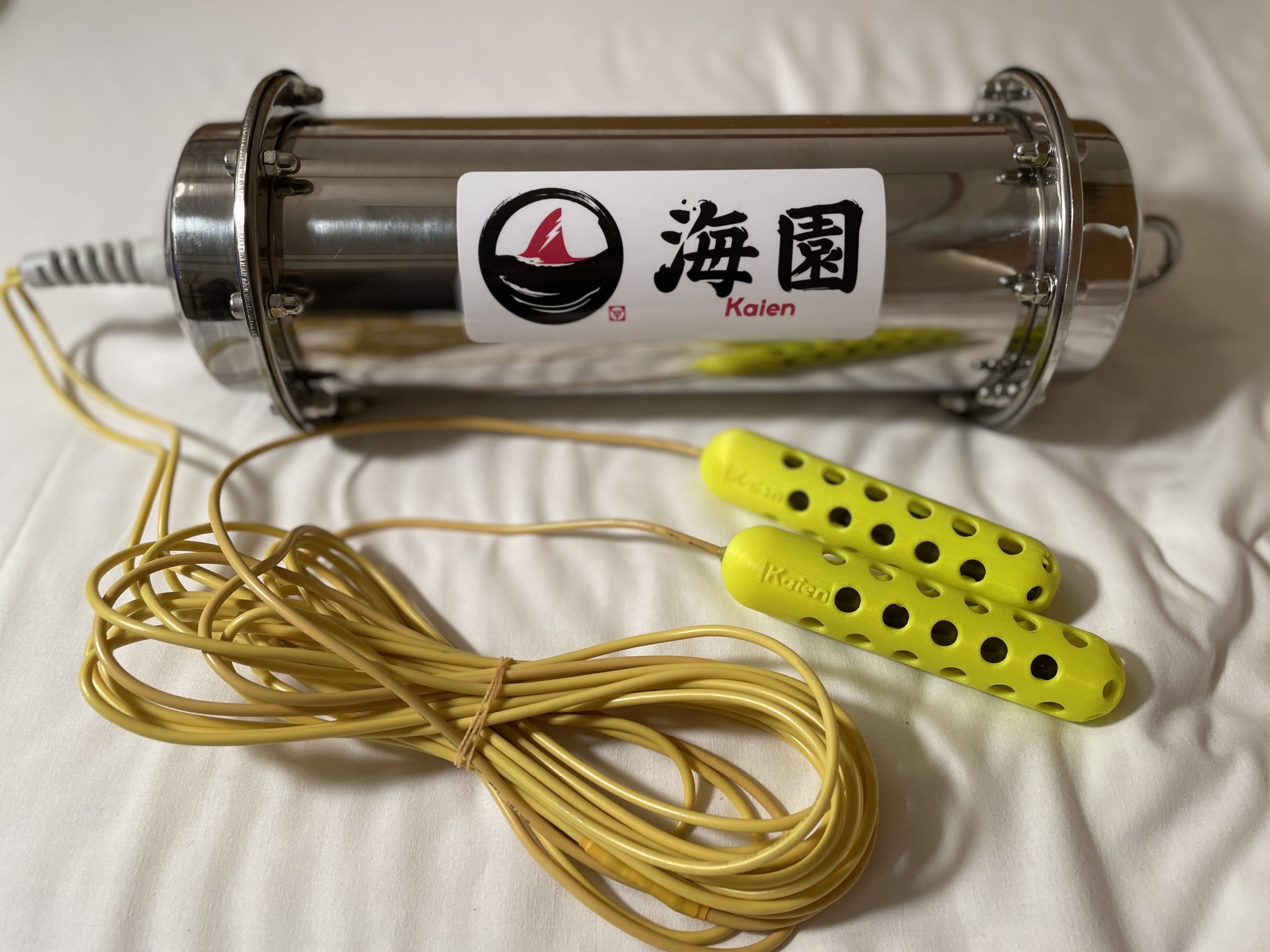 Kaien Farming: stainless steel housing, dual electrode probes, installation cable
 Built for the water.
Built to last.
Kaien Farming is a permanent installation unit. Marine-grade stainless steel housing, dual electrode probes, long-run installation cable. It mounts to the net pen structure and generates a continuous timed electrical field in the surrounding water, deterring sharks before they reach the net.
No batteries to replace. No diver intervention required. No switches or settings. The unit activates on seawater contact and runs.
The Ampullae
of Lorenzini.
ロレンチーニ器官
All sharks and rays possess the Ampullae of Lorenzini: a dense network of electroreceptor cells at the tip of the snout, used to detect the minute electrical fields produced by living prey. These organs are extraordinarily sensitive: capable of detecting fields as weak as 0.01 microvolts per centimetre.
Kaien Farming generates a precise electrical field in the water around the net perimeter. When a shark approaches, its Lorenzini organs are overstimulated. The resulting sensation is intense and aversive. The shark turns away before reaching the net.
The mechanism is not harmful to the sharks. It does not affect the fish inside the net, which lack the Ampullae of Lorenzini entirely. It is species-selective deterrence.
Six regions.
One solution.
Shark interactions with aquaculture operations are documented across every significant fish farming region in the world. The species differ. The damage does not.
Every installation
is different.
Net pen size, water depth, current patterns, and local shark species all affect installation design. We work with operations teams to assess requirements and recommend the right configuration for your site.
株式会社花園 has been developing shark deterrent technology since 2013. All Kaien devices are designed and manufactured in Nagasaki, Japan.
株式会社花園 · Nagasaki, Japan
Replies in English and Japanese within 24 hours.
Personal shark deterrents for fishing, diving, and spearfishing. The same electrical pulse technology in a portable form factor.
View personal devices →